1976 Paralympic Games emerged from brink of collapse to shape Para sport’s future
Paralympic leader Bob Steadward reflects on Toronto 1976, a turning point for the Paralympic Movement
Paralympic leader Bob Steadward reflects on Toronto 1976, a turning point for the Paralympic Movement
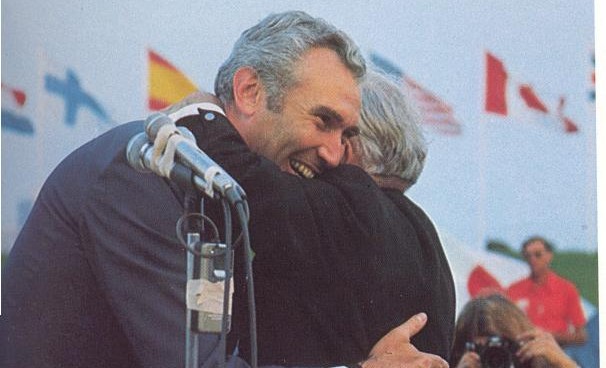
Photo: Dr. Robert Jackson embraces Ludwig Guttmann, father of Paralympic Movement at Toronto ’76 Opening Ceremony
OTTAWA – The 1976 Paralympic Games nearly disappeared before they had a chance to make history.
While South Africa was barred from the 1976 Olympic Games in Montreal because of its apartheid regime, the 1976 Torontolympiad for the Physically Disabled took a different position, allowing South Africa to compete after organizers determined its team was multiracial.
The decision triggered backlash both at home and in the international community.
Eight nations withdrew from what would become known as the fifth Paralympic Games, while the Canadian federal government pulled approximately $500,000 in funding. Even Prime Minister Pierre Trudeau declined to participate in the Opening Ceremony.
Organizers went into survival mode.
‘’Those nations withdrew on the principle of apartheid and not so much on the full integrated team from South Africa,’’ said Dr. Robert Steadward, Canada’s team manager and member of the Games organizing leadership. Steadward would ultimately become one of the most important leaders in growing the Paralympic Games globally and heading Canada’s powerful leadership in the Paralympic Movement.

Dr. Robert Steadward
The Paralympics were teetering on the brink of cancellation and organizers were left scrambling to replace funding and save what would become an important milestone in Paralympic history.
‘’It was right on the edge of a very sharp knife,’’ said Steadward to CPC, from his home in Edmonton. ‘’We were really stressed to do our best to raise the funding required and necessary to host the Games.’’
Spearheaded by Canadian Dr. Robert W. Jackson, president of the International Stoke Mandeville Games Federation at the time, volunteers spent the final four to six months securing sponsorships, donations, and funding from the provincial and municipal governments to keep the Games alive.
‘’Dr. Jackson really worked hard to ensure the money was going to be there,’’ said Steadward, also a professor, sports scientist, coach, and author in his influential career. ‘’He just did not want these Games to fail in any way nor did the City of Toronto.’’
The Games survived the crisis and were a huge success. An impressed federal government redirected its withdrawn funding towards creating a new national organization for athletes with a disability which would eventually become the Canadian Paralympic Committee in 1993.
Back in 1976, there was no agreement between the International Paralympic and Olympic Committees that the Games were held in the same host city.
In 1968 for example the Olympics were in Mexico and the Paralympics in Israel while in 1976 the Winter Olympics were in Austria and the Paralympics in Sweden.
However Dr. Jackson, who died in 2010, was determined to keep the Games in Canada. When Montreal said it was unable to host, he pushed hard to bring the Games to his hometown and accepted the responsibility for organizing Canada’s first Paralympic Games.
Securing the Games wasn’t enough though and Canada insisted on expanding the Games to more athletes with a disability. Before Toronto, the Paralympics were for wheelchair athletes only. In Toronto, events for the visually impaired and amputees were added.
Steadward’s experience in 1976 pretty much solidified his decision to dedicate his life to the Paralympic Movement.
He became the first president of the International Paralympic Committee (IPC) in 1989, a position he would hold until 2001. His name is on the memorandum of understanding with the IOC that one city would host both events.
‘’Once I saw what happened in Toronto in ’76, I said we need to ensure that the future Paralympic Games are inclusive and accessible for all athletes of all disabilities under one organization,’’ said Steadward.
Fifty years later he sees Toronto 1976 as a turning point.
‘’We moved from a medical model to a sport model,’’ he said. ‘’We moved from being treated like patients to being respected as high-performance athletes.
The significance of those Games went beyond sport.
‘’I still look back at it and realize it was a large and wonderful family. That’s what the Paralympic Movement was to me.
‘’It was family.’’

"*" indicates required fields
"*" indicates required fields