From Calgary to Santiago: How funding built a pathway for goalball
"It does really help us to improve and grow the sport of goalball"
"It does really help us to improve and grow the sport of goalball"
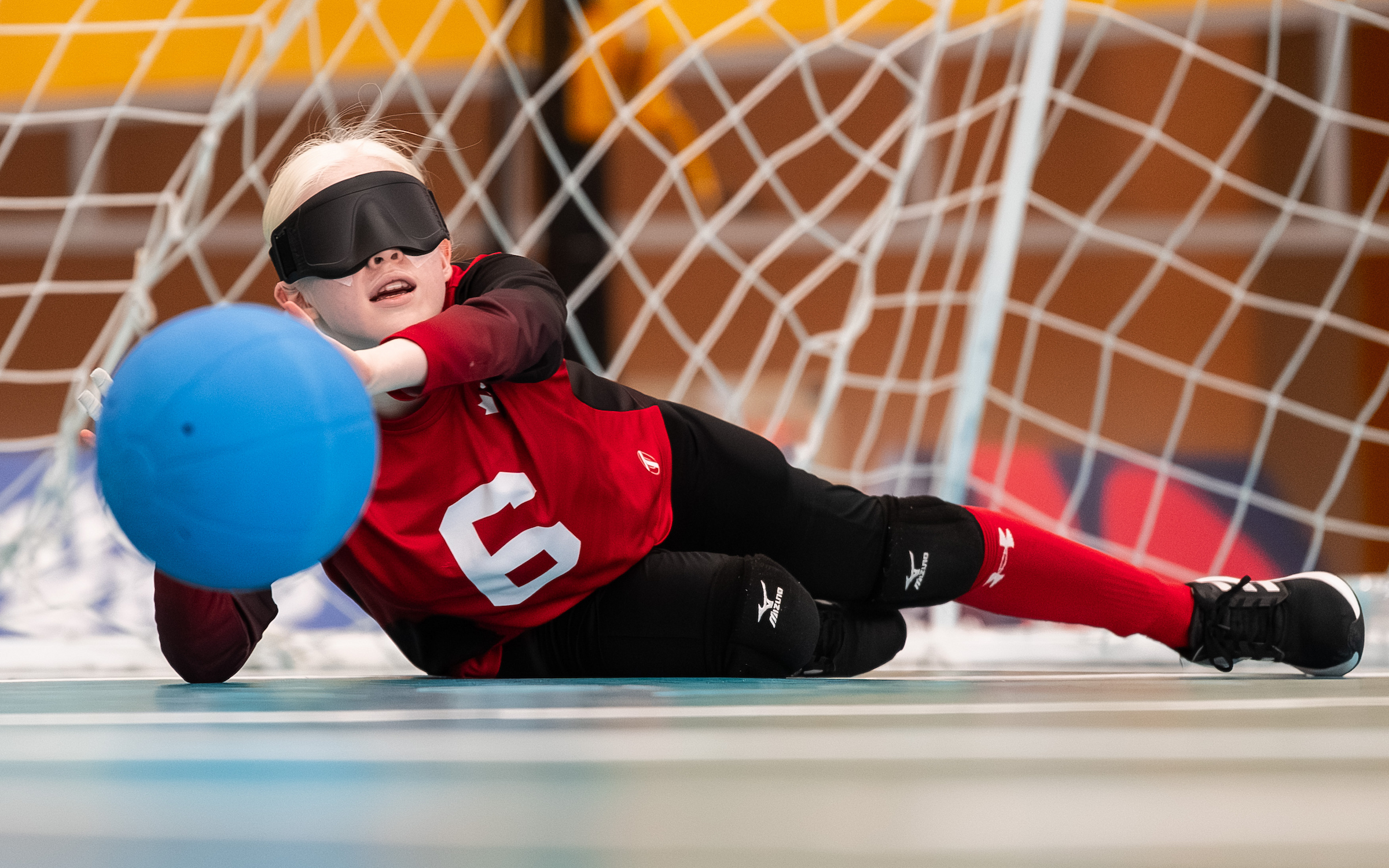
For Arianna Balson, finding goalball started with a simple love of sport.
“I love sports, and finding a sport that I could do while visually impaired was massive,” she says. “I went through all of the training processes. I went to all the training camps. I went to practice every weekend.”
That commitment paid off last year in Santiago, Chile, where Balson competed for Canada’s junior national team at the 2025 Youth Parapan American Games. But the road to Santiago started closer to home, at a training camp in Calgary made possible by a Paralympic Sport Development Fund grant (which has now evolved into two new grant programs aimed at closing gaps in the Para sport system) to the Alberta Sports and Recreation Association for the Blind (ASRAB). Funding for the grant was provided by the Paralympic Foundation of Canada.
Rebuilding a Pipeline
For coach Trent Farebrother, the camp addressed a gap he’d watched grow over decades in the sport.
“When I was playing in the 80s, we had probably 25, 30 men trying out for the provincial team, and then it sort of tapered off for some years. For the last 10 to 15 years, we might have had only six people trying to come out. We didn’t have many juniors,” he says. “But now we’ve actually got a really strong junior program. We’ve probably got 17 athletes here in the province right now.”
The grant is a direct reason why.
“What we did with the grant was run a junior training camp in Calgary with it, so that gave the opportunity to bring in a lot of our juniors,” Farebrother explains. “We were able to host a training camp and identify individuals that we could put on different pathways and everything. The grant made that possible.”
What the Camp Gave Athletes
For Balson, the value wasn’t abstract, it was a chance to see exactly what she was working toward.
“It was so, so important. A lot of people don’t get to do that, and it was really important for all of us to experience what the selection camp would look like, all of the different types of training and routines and everything we would have to do to be selected,” she says. “It was a great experience to see what it would be like and being with all of the different athletes that showed up and getting to train with them.”
One specific skill stuck with her.
“I think learning more about my ups and ins (a skill specific to goalball) during that practice and training camp helped me a lot in Chile. Coming from someone who had recently learned how to do them, and then getting to learn more about it at our training camp, that helped me in Chile.”
She also sees the camp’s value extending beyond her own experience.
“I think it helps the athletes who haven’t done a national camp or a selection camp before, to show them what it’s going to look like and what you need to prepare to get onto that team.”
Farebrother followed the athletes from the camp to Santiago.
“As the head coach of the women’s national team, I’m actively involved in overseeing the junior selection camp. I went down to Chile, as a coach mentor for the four coaches, the two men’s coaches, the two women’s coaches.”
The Payoff in Santiago
For Balson, the Games themselves delivered on everything the camp had pointed toward.
“It was the best experience ever. I loved getting to meet so many new people from so many different places, hearing all the different languages, and being able to play on an actual goalball court for the first time was amazing.”
Farebrother says watching that growth happen is the reason the work matters.
“I think the most rewarding thing is when you see the evolution and the development, and you see them have that ‘aha’ moment where it clicks. It’s amazing because from one year to another, they grow and improve.”
Looking Ahead
Balson’s next target is already set: “I’m hoping to make it to worlds (2026 goalball youth world championships), which is in Kazakhstan.”
And for the program behind her, funding – such as that provided by the Paralympic Sport Development Fund – remains foundational.
“It does really help us to improve and grow the sport of goalball, which is awesome,” Farebrother says.
"*" indicates required fields

"*" indicates required fields